

“There's a man with a gun over there, telling me I’ve got to beware...” — Buffalo Springfield
Last week, historian Heather Cox Richardson, in a YouTube post, reported how the Federal Communications Commission pressured CBS into cutting a segment of Stephen Colbert’s show where he talked with James Talarico, candidate for one of Texas’s two US Senate seats. She explained how this was the second time the FCC had squelched a Talarico interview, which, for her, raised the question, “Why him?” Her answer might surprise you. She believes it’s not because of his politics but his religion.
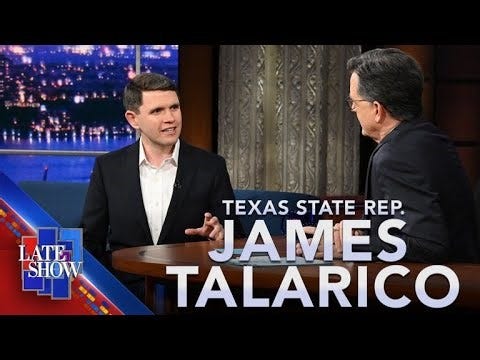
“What Talarico has,” she explained, “Is less about the Senate seat than it is about the fact that James Talarico is a seminary student.” But that’s only part of it. He’s also Anglo, a dyed-in-the-wool Texan (“I’m an eighth-generation Texan,” he says. “My family has been in our state since it was Mexico,”) and, on top of that, a religious scholar.
That means that this humanitarian faith he’s espousing can’t be written off as that of a “Black liberal”, an “angry woman”, someone who “isn’t a Southerner”, or who doesn’t “know the Bible.” None of those well-worn dismissals applies to him. So, here we have this Kennedy-looking, twang-speaking, native Texan who’s committed to an America that works for all of us. And he got there by, of all things, studying the Bible. Who knew?
As a result, James Talarico is like a torpedo through the core of the totalitarian faith battleship. He’s gone after Christian nationalism with both barrels, claiming that it’s not just un-American; it’s un-Christian. “He was supposed to be here,” Colbert says at the start of his show, “But we were told in no uncertain terms by our network’s lawyers, who called us directly, that we could not have him on the broadcast. Then I was told in some uncertain terms that not only could I not have him on, I could not mention not having him on. And, because my network clearly doesn’t want me to talk about this, let’s talk about this…”
“I AM going to interview James Talarico tonight,” Colbert continued, “But – it’s not going to be on the Late Show. It’s gonna be on the Late Show’s YouTube page. The network says I can’t give you the URL or a QR code, but I promise you, you go to our YouTube page, ya find it…”
“You are a Presbyterian seminarian,” Stephen asks, launching right into his conversation with James, “Presently? You’re a seminarian?” James affirms that yes, while serving in the Texas State House, he is. “The Right attempts to co-opt Christianity,” Colbert responds, “To say that… you can’t actually be a Christian and be a Democrat. But,” he pauses, “The Religious Right is largely a political movement that references spirituality, but it’s a political movement. What is your… heartfelt hand, out to the people who want to use religion as a tool of political power?”
“Well, for 50 years, the Religious Right—a political movement—that’s the perfect description for it,” James affirms, “Convinced a lot of our fellow Christians that the most important issues were abortion and gay marriage. Two issues that aren’t mentioned in the Bible. Two issues that Jesus never talked about. Jesus in Matthew 25 tells us exactly how you and I, and every one of our fellow believers, how we’re going to be judged, and how we’re going to be saved. By feeding the hungry, by healing the sick, by welcoming the stranger. Nothing about going to church, nothing about voting Republican. It was all about how you treat other people.”
The largely a-religious crowd you’d expect to find in a late-night talk show audience breaks into resounding applause. “My granddad was a Baptist preacher in South Texas,” James continues. “And, when I was little, he told me that Christianity is a simple religion. Not an easy religion, he would always clarify. But a simple religion because Jesus gave us two commandments: Love God, and love neighbor. And there was no exception to that second commandment. Love thy neighbor regardless of race or gender or sexual orientation or immigration status or religious affiliation.”
Heather Cox Richardson, in her video, explained how powerful it is that someone who, by everything from ancestry to religious heritage, should epitomize Christian nationalism is actually exposing it for what it is, how James’ insistence on the separation of church and state is grounded in his commitment to both. “What he has done, as, really, kind of his hallmark,” she says, “Is he has taken on the Christian claims of the white nationalists, of the white Christian nationalists.”
If you’ve read any of my other letters, I’m guessing you’ve already figured out that the misuse of religion to render unspeakable harm is a core theme for me. Part of that’s because the social institution itself, the “church” in “separation of church and state”, has been entrusted by us, the American people, with doing the opposite. Instead of aiding and abetting inhumanity, it should be resisting and abolishing it.
“The church must be reminded that it is not the master or the servant of the state,” Martin said, “But rather the conscience of the state. It must be the guide and the critic of the state, and never its tool. If the church does not recapture its prophetic zeal, it will become an irrelevant social club without moral or spiritual authority. If the church does not participate actively in the struggle for peace and for economic and racial justice, it will forfeit the loyalty of millions and cause men everywhere to say that it has atrophied its will.
But if the church will free itself from the shackles of a deadening status quo, and, recovering its great historic mission, will speak and act fearlessly and insistently in terms of justice and peace, it will enkindle the imagination of humankind and fire the souls of men, imbuing them with a glowing and ardent love for truth, justice, and peace.”
There’s something particularly pernicious about the kind of betrayal of trust that Martin is addressing with respect to organized faith in America, the kind where the bankers are doing the robbing, the firefighters, the arsoning, the caregivers, the abusing. Where the foxes have wormed their way into guarding the henhouse.
In everything from The Gospel According to Gaga to The “Division” Distraction, I’ve tried to show how we can’t begin to make sense of what’s happening in our country, politically, without grasping what’s happened to us, spiritually. Then, there’s my personal journey. Despite being born in Birmingham, the heart of the Civil Rights movement, growing up in a family that was at the core of it, and taking up Kingian-style activism from boyhood onward, I was a college senior before my conscious mind caught up with where my instincts had long been heading.
That’s when I realized that the contributions I most wanted to make would be better made through ministry, rather than medicine, by helping foster the same humanitarian faith that compelled historically white churches in 1978 Birmingham to help elect the city’s first African American mayor, the only person on the ballot committed to a Birmingham for all Birminghamians.
That work, helping our nation do something similar, become a “For All” America, has been my longstanding focus, and is the same sacred work that James Talarico and Stephen Colbert are doing. Both of them, in their own unique ways, are challenging us Americans to be a better people than the one we’ve so often been.
“It is bad for any religious organization, and certainly my church,” says Colbert, “To associate itself with any political party. How must it diminish God to be associated with something so small as a present political party. Because, imagine this – imagine that you managed to co-opt Christianity, imagine if you manage to convince everybody that Jesus is on your side, because, if you then lose the election, sounds like you’ve got a pretty weak Jesus.”
Across the globe, we’re discovering that faith systems, like all social institutions, are what we make of them. And for us Americans, that spans from having used it for evil, baptizing slavery, blessing racial violence, and declaring that this land belongs only to some of us, to using it for good, awakening our conscience, finding the courage to stand for others, and recognizing that nothing matters more than the line in the grand human story we use our lives to write.
James Talarico believes that his message about what Christianity should truly be about is the reason Christian nationalists are so obsessed with silencing him. And from everything I know about them, a group that’s spent the last half-century building, from the ground up, an opposing orthodoxy to the humanitarian faith espoused by everyone from Martin to Mister Rogers, I think James is right.
That’s why this defining moment is about so much more than the people currently holding the reins of power. It’s about the malicious machine this faction has built, how it was designed to directly combat the advances being made by humanitarian faith, and how they sought to remake their image from perpetrators of lynchings and enforcers of segregation to the defenders of so-called family values.
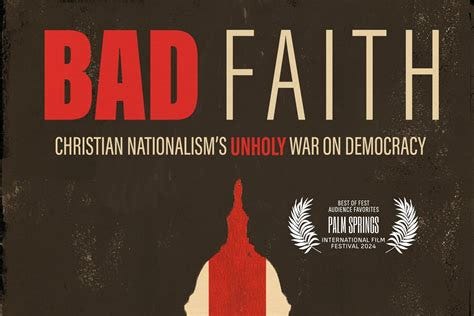
“Okay,” you might be thinking, “I get that they’ve done some bad things in the name of God, but what does this have to do with politics, or governance, or democracy?” And that’s exactly the right question. It’s one that Panarea Productions, in their 2024 documentary, Bad Faith: Christian Nationalism’s Unholy War on Democracy, sought to answer. Check out the trailer immediately below:
I have to say, this documentary does a better job of encapsulating totalitarian religion’s emergence as a political force in the United States than perhaps any one film I’ve ever seen.
It starts with a definition of Christian nationalism, describing it as “A political movement that believes America was founded as a ‘Christian Nation’, privileging Christianity over all other faiths.” The film convincingly shows that what we’re dealing with is a kind of nationalism, not a kind of Christianity, in the same way “American cheese” is a kind of cheese, not a kind of American. “Christian” is the modifier in the phrase, not the noun.
Despite its name, the ideology is no more about being a “good Christian” than Russian communism was about being a “good Russian” or Nazism was about being a “good German”. It’s not about our religious beliefs. It’s about our beliefs about our religious beliefs, whether our specific faith grants us ruling authority over the nation, or, as televangelist Pat Robertson put it, “Rule the world for God.”
Like the medieval Crusades (from “taking the cross”), Christian nationalism’s first iteration, this newest version claims it has a divine dictate to do whatever is necessary, moral or immoral, to claim power. “And from the days of John the Baptist until now, the kingdom of heaven suffers violence,” they proudly quote, as rationale for their actions. “And the violent take it by force.” They went to bed as America’s saviors. And woke up as its Taliban.
“I think it’s time we stop, children, what’s that sound? Everybody look what’s going down.” — Buffalo Springfield
Part of what makes Bad Faith so compelling is its use of actual footage featuring this faction’s leaders and architects, boldly, in no uncertain terms, speaking their intentions to manipulate, if not outright eliminate democracy. “Our movement will be entirely destructive,” says a strategy paper commissioned and circulated by effort architect Paul Weyrich, “And entirely constructive. We will not try to reform the existing institutions. We only intend to weaken them, and eventually destroy them.”
Then, there’s the ideology’s broad range of critics across the faith spectrum, from born-again, pro-life social conservatives to believers in liberation theology, from Russel Moore, Editor-in-Chief of Christianity Today, to Rev. Dr. William Barber, Co-chair of the Poor People’s Campaign, people who, despite having scarcely any common ground, nevertheless all agree on the dire threat this ideology poses. “It would disturb me if there was a wedding between religious fundamentalists and the political right,” said Rev. Billy Graham in 1981. “The hard right has no interest in religion except to manipulate it.”
Spiritual activist and public theologian Jonathan Wilson-Hartgrove, like James Talarico, both Anglo and Southern, explains in the film how Christian nationalism was never about what he calls “shaping people into the way of Jesus.” “This movement has been about scaring white Christian people into believing that there is an enemy out there that is going to obliterate you,” he concludes. This work, standing up to injustice, whether religious or secular, being what Martin called “the conscience of the state,” is exactly what Jonathan has spent a lifetime doing.
Activist Ann Atwater, both female and African American, whose story, along with CP Ellis’, was told in the 2019 film, The Best of Enemies (and who you might remember reading about here), was his long-time mentor. And in 2003, he was part of a team that traveled to Iraq to let Iraqis know that not all American Christians were in favor of what our nation was doing to theirs. That, in fact, some of us were horrified by the war, that we acknowledged the blood on our hands, and that we were doing everything we could to stop it. To, as Martin said, subpoena the conscience of a nation.
Bottom line, where we come down on this one thing, whether or not we believe that our group’s religion should dictate how our nation is governed, is the difference between being a democracy, government by all of us for all of us, or a fascist state, government by the few and for the few. And if we’re not a democracy, if your or my particular faith really is allowed to supplant the Constitution, we’ve stripped the people, the body politic, of power, bequeathing it to whoever is willing to sink the lowest, to do the most unspeakable. To silence their conscience.
Grasping this leads to two key takeaways. First, turns out that all forms of nationalism and authoritarian ideology, whether based on Christian, Muslim, atheist, or Communist thought, whether rooted in race ideology (white supremacy/Nazism) or tribalism (genocides around the world), share remarkable similarities. Strip away the symbology and terminology, and the practices and rhetoric are surprisingly the same.
The second, equally important point the film makes is that while this all feels new, it isn’t. The movement is one that emerged out of the segregationist takeover of the Republican Party itself in the late ‘60s, then went public with the launching of the Moral Majority in the late ‘70s. So, while we think this is about the most recent presidential election, the real story is about a ruthless political machine that’s been dressed up to look like religion. Not unlike the “Christian” Knights of the Ku Klux Klan, and its calling card—a burning cross.
When you think about it, what they’ve pulled off is really kind of brilliant, in the worst way possible. They’ve successfully done what any dwindling faction resistant to relinquishing power does—stage a coup, one they’ve been laying the groundwork for since the passage of the 1965 Voting Rights Act.
They, in a head-spinning case of word-weighting, rebranded themselves the “moral majority”, a term coined by Paul Weyrich, and popularized by televangelist Jerry Falwell, cofounders of the organization by the same name, when they were effectively neither. “When government is in the hands of godly men,” one speaker declares in Bad Faith, “It is good. But in the hands of all others, it is evil.” “Fuck democracy,” another bellows to a crowded room, “I stand with Jesus Christ.”
But the thing is, this was always a battle that nationalism, whether the racial variety back in the ‘60s or the religious version today, was destined to lose. That’s because the arc of the moral universe really does bend toward justice.
“Do to us what you will,” Martin said in a 1964 address delivered at the Methodist Student Leadership Conference in Lincoln, Nebraska, “And we will still love you. Bomb our homes and threaten our children, and as difficult as it is, we will still love you. But be assured that we’ll wear you down by our capacity to suffer, and one day we will win our freedom. We will not only win freedom for ourselves, we will so appeal to your heart and conscience that we will win you in the process, and our victory will be a double victory.”
This is what true moral fiber looks like.
“What they don’t realize,” says Bad Faith producer and director Stephen Ujlaki, “Is that once you have an authoritarian regime that systematically excludes certain people from power, you’re going to be one of those people at some point.”
If Bad Faith is an exposé of Christian nationalism, then James Talarico’s message is a perfect example of how it’s dismantled. And right now, in Texas, of all places, both he and equally formidable Jasmine Crockett, an African American US Congresswoman, are doing just that. They’re both gunning for John Cornyn’s seat, the US senator I quoted in, Tear It Down (Or, This is Your Brain on Word-Weighting), even as the senator fights off Republican contenders. Cornyn, after SCOTUS struck down Roe v. Wade, thought it was a good idea to tweet, “Now do Plessy vs Ferguson/Brown vs Board of Education.” He did this despite Texas’s current unprecedented demographic shift.
In Freedom Land 2: The Bad Guys, I described how activists I’m mentoring and supporting are engaged in extensive on-the-ground organizing in Texas, which, in 2021, joined Hawaii, New Mexico, California, Nevada, Maryland and Georgia as majority-minority states. This new, diverse America isn’t just our future but our present. As of 2019, every American under 18 is now part of a generation where no ethnic/racial group is a majority.
And that’s exactly how they want it. They believe we’re a fundamentally better nation with no one holding prevailing power. So, unless our government is willing to expel literally millions of non-Anglo children, this is a demographic bell that can’t be unrung. In less than 20 years, every state will be non-majority.
“Young people speaking their minds, getting so much resistance from behind.” — Buffalo Springfield
Yet, the great state of Texas has recently adopted some of the most restrictive voting laws in existence, no doubt, hoping to prevent this new nationalism-opposing majority from being represented fairly at the polls. And for Christian nationalists, losing Texas, which has more Electoral College votes than any state except California, would be catastrophic, making it all but impossible for them to ever win the presidency again. This is why what’s happening in the Lone Star state is so important, both this year and in 2028.
Rep. Jasmine Crockett, addressing Colbert’s extraordinary efforts to make sure his interview with James Talarico, her opponent in the Democratic primary, saw the light of day, refused to be drawn into the trap of putting her own campaign above the fundamental issues at stake. She gets it, declaring simply that airing that interview was an act of resistance, an affirmation of democracy, exactly what we need right now.
Last year, in her second appearance on the Late Show, she waded right into transgender athletes, the latest hot-button issue designed to do what Christian nationalists have been doing since Anita Bryant and the so-called “homosexual agenda”, distract us from their assault on democracy. (If you want to get a sense of why Rep. Crockett is so extraordinary, you can watch her Colbert interview here.)
In the end, I love how James Talarico’s granddad described Christianity as a simple religion. “Not an easy religion,” he clarified, “But a simple religion.” That’s because of those two commandments: Love God, and love neighbor. “Don’t tell me what you believe,” James continued, “Show me how you treat other people, and I’ll tell you what you believe.” He also gets it.
And Heather Cox Richardson? The reason she, a political historian, was covering this in the first place is that she, like James and Jasmine, also gets it. She grasps that, like Buffalo Springfield sang, “There’s something happening here”. (“But what it is, ain’t exactly clear.”) What that “something” is is the use of a tool—in America’s case, co-opted religion--to turn us into a totalitarian state. A “nation”, as defined by them, under “God”, as articulated by them.
But what this dwindling faction doesn’t get is that their 50-year reign, their heady days as the religious Big Bad Wolf, are already over. All that’s left for them is to decide whether they want their children to have a place in the “For All” future we’re forming, the true democracy we’re finally becoming, or not.
In The Turning of the Tide, Part Two, I described how psychologist Stanley Milgram, in the 1950s, showed that, despite incredible levels of discomfort, two-thirds of independent-minded Americans could be persuaded to incrementally increase electric shocks to the maximum 450-volt level, despite knowing it to be fatal to the victim, then delivering this fatal shock three times. They did this simply because a man in a lab coat told them to. Imagine what happens when these men are waving Bibles, wearing clerical collars or claiming to speak for God.
“You have no other choice,” Milgram, the experimenter, told them, “You must go on.” But they did have a choice. As do Americans today. And choice changes everything. “There is nothing Christian about Christian nationalism,” James Talarico concludes. “It is the worship of power in the name of Christ, and is a betrayal of Jesus of Nazareth. Politicizing Christianity distorts politics and cheapens faith.” I don’t think it can be better said than that.
Bad Faith is available to be viewed on Apple TV+, Amazon Prime, Google Play and YouTube, for purchase or subscription, and on TUBI for free.
In addition, the website includes an extensive list of books used as source materials for the film.
The Late Show with Stephen Colbert, featuring James Talarico, can be seen here:
The Late Show with Stephen Colbert, featuring Jasmine Crockett, can be seen here:
And finally, below are links to some of my writing that covers similar territory: