


May 4, 2025
Meet the Press’ Kristen Welker: Your secretary of state says everyone who’s here, citizens and non-citizens, deserve due process. Do you agree, Mr. President?
Trump: I don’t know. I’m not, I’m not a lawyer. I don’t know.
Kristen: Well, the Fifth Amendment says as much.
Trump: I don’t know. It seems — it might say that, but if you’re talking about that, then we’d have to have a million or 2 million or 3 million trials. We have thousands of people that are some murderers and some drug dealers and some of the worst people on Earth.
Kristen: But even given those numbers that you’re talking about, don’t you need to uphold the Constitution of the United States as president?
Trump: I don’t know.
January 20, 2025
“I, Donald John Trump, do solemnly swear that I will faithfully execute the office of president of the United States, and will, to the best of my ability, preserve, protect and defend the Constitution of the United States, so help me God.”
This might be the most important letter I write. Because, in it, I’m trying to draw our attention to two events, each unprecedented in their significance, that are happening simultaneously.
The first is encapsulated in the above interview. Granted, over our 250-year history, we’ve had presidents that have ranged from great to awful to forgettable. But never has any of them expressed anything less than absolute adherence to the sanctity of the Constitution and to their oath to preserve, protect and defend it. But, that’s exactly what Donald John Trump did, less than four months after solemnly swearing an oath to do just that. For the second time. It’s not possible to overstate how significant this is.
Trump apologists will try to say that, of course, he didn’t mean that he doesn’t know if his job is to uphold the Constitution. He was saying something else. But he wasn’t. The question was clear. There are times when the only appropriate answer is “yes”. This was one of those times. And on whether everyone deserves due process? He says, “I don’t know”, but he indicates that he does. His rationale for skipping right to the sentencing? “…Some murderers and some drug dealers and some of the worst people on Earth.” Which he knows, how? Clearly not because they had a trial. We used to do this all the time. It’s called, lynching.
There are also times when “I don’t know” is an unqualified “no”. Like, “Do you take this person to be your lawfully wedded spouse?” (“I don’t know.”) “Should women have rights equal to men?” (“I don’t know.”) “Is slavery immoral?” (I don’t know.) This was one of those times. Because upholding the Constitution isn’t some side issue, like whether it’s okay to peddle Teslas on the White House lawn. This is the job. The only job. Everything else is secondary. Anyone who spent that much time on The Apprentice must know how job descriptions work.
Even in those first 100 days, there were all kinds of examples that this wasn’t just a gaffe. That both he and the people he’s surrounded himself with believe that it is, in fact, not his job to uphold the Constitution but to “take America back” or make it “great again”. Everything from shutting down federal agencies without congressional approval to efforts to end birthright citizenship, guaranteed by the Fourteenth Amendment. From the Heritage Foundation’s Project 2025, which sought to render Congress and SCOTUS powerless to their Project Esther, which seeks to label peaceful protestors, “terrorist sympathizers”.
Or, take people like Kilmar Abrego Garcia. Kilmar, a union sheet metal apprentice and father of three from Maryland, was stopped and detained by ICE agents on March 12 while driving home from work. He had both a work permit and a court order protecting him from deportation. That documentation was ignored. Kilmar was rushed onto a plane, transported, in violation of the law, to El Salvador, and imprisoned—for life—without even a sham trial, along with 238 other people on that flight.
The Trump administration has tried to call this “deportation”. But that’s about as true as calling Auschwitz a “work camp” or Vietnam draftees, “volunteers”. Because deportation is a legal process, one involving an actual arrest, incarceration, a removal order from a judge and finally, if all those legal hurdles are cleared, a flight out of the country. That’s how it should work. But the Trump administration has decided that the legal process doesn’t apply to those it’s targeted for expulsion. “We’d have to have a million or 2 million or 3 million trials,” was Trump’s answer to why upholding this facet of the Constitution is too burdensome.
This is so far beyond politics. It’s so much bigger than whether we voted for Trump, or Kamala, or didn’t vote at all. This is something that should be setting off alarms in the hearts of everyone who believes in the rule of law and justice for all. Because a president, no matter the party, who “doesn’t know” if he’s obligated to uphold the Constitution isn’t a president. He’s something else. And everything he does, everything we allow him to do without resistance, and us neither forcing him to do his job nor firing him and everyone who enabled him, is on us.
Right this moment, there’s nowhere we can look and not see evidence of the harm being rendered – to ethnics and the poor, LGBTQ+ people and women, immigrants and refugees, non-Christians and non-capitalists. But, we’re not resisting. Part of that’s because the perpetrators of these injustices have thrown down the gauntlet: “If you’re not with us, you’re against us.” So, we fall in line, sticking to the narrative. We insist that our land is a fair and just place, that all that crying is over fake news, and if, somehow, it really is real, it must be justified. The fact that the people in charge are doing it is ample evidence that it must be right – exactly what Erling Solheim, Gunnar Sønsteby’s childhood best friend and neighbor in the biopic Number 24 thought.
In one scene, young Gunnar, in 1937, is wadding newspaper to start their fire up in the snowy mountains when he sees a headline:
Gunnar: This is incredible. [sighs]
Erling: What?
Gunnar shows Erling the headline – NAZI BOOK BURNING CAUSES INTERNATIONAL WORRY
Erling: Book burning?
Gunnar: I got a book from my father. A guy called Langhoff, who has written about his stay in a German concentration camp. They'll burn that in no time.
Erling: Concentration camp?
Gunnar: Yes. It says they've been detaining folk who are against the regime.
Erling: Communists, then?
Gunnar: A mix of people, I think. It's called The Peat Bog Soldiers. Khn has it in his bookshop. Or I can lend you mine.
Erling: I understand they’re doing that, um, to keep the communists under control. It’s the same here, as well. Or else, I mean, it’s Moscow for all of us.
Gunner: You’re not hearing what you’re saying, are you?” Shouldn’t people be free to say what they want?
Erling: Sure, sure.
Gunner: It’s not about communism. We should be allowed to speak and not go to jail.
Erling: Yeah, but you get what I mean, right?
Gunner laughs: No, I don’t know what you mean.
Young Erling had uncritically accepted and repeated the same rationale he’d heard, that certain measures were necessary to keep the communists, the “worst people on Earth”, under control. Gunnar challenged that framing, stating that it wasn’t about communism. It was about freedom. It was here, this seemingly innocuous decision about book burning, that their entire life trajectories diverged.
Gunnar repeatedly put his life on the line for his country against German occupation. Erling, by going along to get along, betrayed the same country. 94-year-old Gunnar was the highest decorated person in Norwegian history when he died. Erling died a young man, left on the snowy mountainside, alone, unburied and uncelebrated. Gunnar is remembered for the stands he took. Erling, for those he didn’t take.
“Did you say it was a shame when he died?” sang Phil Ochs about the 1963 murder of Civil Rights activist and mail carrier William Moore, “Did you say he was a fool because he tried? Did you wonder who had fired the gun? Did you know that it was you who fired the gun? Did you say it was a shame when he died?” Like Erling and Gunnar, we, right now, are choosing not just our shared fate but how you and I will be remembered.
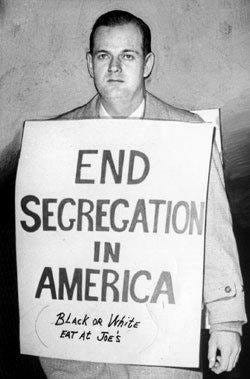
We’re making comparable choices each time we decide whether our company will uphold its commitment to diversity, or the university will arrest people for protesting, whether we’ll hide slaves in our barn, Jews in our attic or immigrants in our churches. Or, whether we’ll allow our president, when asked if he’s obligated to uphold the Constitution, to say, “I don’t know.”
This moment, right here, is one we’ve never faced before. We’ve never had an entire administration that acts as if the rule of law doesn’t matter. The ideals upholding democracy itself have never been this fractured. And we’ve never been this unconcerned.
Still, as significant as this is, it’s the less consequential of the two unprecedented events happening right this minute. That’s because, despite the damage this ideological faction is doing, its days are numbered. It’s not about the short-lived supremacy state they think they’re building, their 1,000-year Reich that will turn out to not even be the 10-year Reich the Nazis had. It’s about what comes after.
Somewhere along the way, we lost sight of a core principle of vital societies; that when we obliterate all viable nonviolent reform efforts, the only means of saving one’s self left to people are violent ones. In other words, the greater the oppression, the bigger the explosion. That’s especially true in our new demographic landscape, one where the oppressed aren’t just the new majority. They’re angry beyond measure. Or, as the Chicks put it, “I’m not ready to make nice. I’m not ready to back down. ‘Cause I’m mad as hell, and I don’t have time to go round and round and round.”
We’ve seen bits of this before. Our pushback against things like the passage of the 1965 Voting Rights Act is but one example. We told them that none of their marching and their singing was going to change anything. That, sure, they could sit at the front of the bus if they want, but it was going to cost them in jobs, housing and education.
They were going to have their community flooded by drugs and police brutalizing its members. They were going to see white-identifying men like Harlon Carter, future head of the NRA, gun down people like 15-year-old Ramón Casiano in cold blood, and not serve a day of jail time. We’d teach them that nonviolence doesn’t work. And the result? A generation whose hope that we could be a better people had been extinguished.
In Why? (The King of Love Is Dead), I describe how people’s lives were no better after the passage of those historic civil rights acts than they’d been before, and how backlash – where the in-power group punishes the oppressed group for every step toward parity that it takes – made them worse. They were ridiculed at funerals for slain civil rights activists, pelted with garbage for integrating schools, castigated by our politicians, constantly threatened and berated, deprived and neglected. “March all you want,” they were told. “You’ll never win. Because we’ve got the numbers.”
So, people stopped marching. They started fighting. They did what the Black Panthers did and started policing the police. They did what the Young Lords did and forced NYC to resume garbage pickups in their neighborhood. They did what the first Rainbow Coalition did, and banded together across racial dividing lines to stand against their oppressors, our own government. And if that was all, this would be a wonderful story. But it isn’t. Because segregationists, by their actions, and we, by our inaction, broke something precious – that generation’s belief in the power of nonviolent action to form us into a more perfect union.
Take SNCC – Student Nonviolent Coordinating Committee, which changed its name to Student National Coordinating Committee. By 1965, the organization had seen 3 project workers killed; 4 people critically wounded; 80 beaten, and 1,000 people arrested. There’d been 35 shooting incidents, 37 churches bombed or burned; and 30 black businesses and homes burned. While marchers were still trapped in Selma, hundreds of SNCC members marching in Montgomery were met by the sheriff's posse who, on horseback, brandished actual whips – the kind once used to keep slaves under control – against them.
Students refused to run. Instead, they moved directly in front of the officers on horseback, daring them to trample them. Others threw bricks and bottles at anyone raising whips against them. SNCC cofounder James Forman, given the Johnson administration’s reluctance to offer them protection from the governor of Alabama, warned that "If we can't sit at the table of democracy, we'll knock the fucking legs off." We turned them into that. Today, we’re running around yelling “Make America great again.” But all they wanted was to make America good. For the first time.
“The question tonight, as I understand it,” Malcolm X said in his most famous speech, “Is ‘The Negro Revolt, and Where Do We Go From Here?’ or ‘What Next?’ In my little humble way of understanding it, it points toward either the ballot or the bullet.”
That’s where Malcolm, after all he’d endured, from a mother who was the product of rape (his white grandfather raped his black grandmother) to the white supremacy group that likely killed his activist father, to the US senators claiming they’d fight, “to the bitter end,” any movement toward social equality, had arrived. And as he spoke, he channeled the rage of a generation. Now, imagine what it will be like when the oppressed hit that same boiling point - when the pressure in the volcano builds. Only this time, they’re not some insignificant minority. They’re the majority.
In the past, our response has been cracking down; declaring them to be threats to America (as if the people being persecuted and finally resisting are not part of America), and marshalling the full force of the United States government, both sanctioned and unsanctioned, legal and illegal, to stamp out resistance “by any means necessary”. But as all kinds of authoritarian governments before us have shown, trying to crush an uprising is the best way to fuel it.
It’s what Fred Hampton was declaring when he said: “You can jail a revolutionary, but you can't jail a revolution. You may run a liberator like Eldridge Cleaver out of the country, but you can’t run liberation out of the country. You might murder a freedom-fighter like Bobby Hutton, but you can’t murder freedom-fighting.” That’s because, in an oppressive state, there will always be an event that prompts an equal and opposite response from the oppressed. There will always be a reckoning. Always. Malcolm, in The Ballot or the Bullet, continued:
“I'm not anti-Democrat, I'm not anti-Republican, I'm not anti-anything. I'm just questioning their sincerity, and some of the strategy that they've been using on our people by promising them promises that they don't intend to keep. When you keep the Democrats in power, you're keeping the Dixiecrats in power. A vote for a Democrat is a vote for a Dixiecrat. That's why, in 1964, it's time now for you and me to become more politically mature and realize what the ballot is for; what we're supposed to get when we cast a ballot; and that if we don't cast a ballot, it's going to end up in a situation where we're going to have to cast a bullet. It's either a ballot or a bullet.”
This is exactly why our refusal to address the oppression when people protest peacefully makes non-peaceful means inevitable. Because it’s the only card left. And that’s why we’re all culpable. Because we painted them into a corner and rendered them both mute and invisible, all while keeping our heads down. Like we did with AIDS. Or, when we learned what the Nazis were doing, but we refused to get involved. We tell ourselves, “Don’t borrow trouble; let tomorrow take care of itself.” But the future we’ll meet tomorrow doesn’t just happen; we are, by our actions, choosing it today. Just like Erling and Gunnar did.
Take police killings. You’d think we would have learned something from how the many deaths; from 18-year-old Michael Brown, 12-year-old Tamir Rice and 14-year-old Emmitt Till, to 17-year-old Trayvon Martin, who was shot and killed because he was walking along a Florida sidewalk at night, and 22-year-old John Crawford, who was gunned down in a Wal-Mart for carrying a toy gun he’d picked up off a Wal-Mart toy shelf. His last words were, “It’s not real” – this, at the same time that white nationalists were brazenly carrying actual loaded weapons in stores like Wal-Mart. But we didn’t. Learn.
In fact, it was our inaction and indifference that made the 2020 protests a worldwide phenomenon. The explosion was an inevitability. The only thing we didn’t know was when. Those protests resulted in the largest voter turnout in US history and set us on a course toward long-deferred justice. But now, here we are, nullifying the same reforms we’ve spent the last four years enacting and going so much further.
In four months, this administration has obliterated decades of progress, regressing us on everything from policing reform to gender identity, from a Justice Department that’s championing injustice to efforts to sue law firms into silence. But none of this happened magically. It’s the result of a longstanding effort to rewind the clock to our supremacy days, only to discover we’re no longer the people we were back then.
You start out in 1954 by saying, ‘Nigger, nigger, nigger’. By 1968 you can't say ‘nigger’ – that hurts you. Backfires. So you say stuff like forced busing, states' rights and all that stuff. You're getting so abstract now, you're talking about cutting taxes, and all these things you're talking about are totally economic things and a byproduct of them is blacks get hurt worse than whites. And subconsciously maybe that is part of it. I'm not saying that. But I'm saying that if it is getting that abstract, and that coded, that we are doing away with the racial problem one way or the other. You follow me – because obviously sitting around saying, ‘We want to cut this,’ is much more abstract than even the busing thing, and a hell of a lot more abstract than ‘Nigger, nigger’.
That’s how Reagan administration staff member and New Right political strategist Lee Atwater, in a 1981 confidential interview described his party’s effort to rebrand themselves. It’s what I call “supremacy math” – the recognition that when you have vastly superior numbers, you can wreak unilateral havoc and ultimately, it will be in your group’s favor.
So, let’s say your group has 90 people and theirs has 10, all in the same town. And let’s say you shut down the factory that sustains 20 households in that town. And let’s say those job losses are equally distributed – 10 in your group and 10 in theirs. Sure, there’s some pain experienced by your group, where 10 of your 90 households can no longer make a living. But their group? 100% of their households are out of work. Simply based on population, it hurts them more than it hurts you. And that’s before taking into account things like over-ticketing on their side of town, sentencing disparity, or preferential decisions in housing or hiring.
Atwater began this segment by saying, “As to the whole Southern strategy put together in 1968, opposition to the Voting Rights Act would have been a central part of keeping the South. Now, you don't have to do that. All that you need to do to keep the South is for Reagan to run in place on the issues that he's campaigned on since 1964, and that's fiscal conservatism, balancing the budget, cut taxes, you know, the whole cluster.”
Interviewer: “But the fact is, isn't it, that Reagan does get to the [George] Wallace voter and to the racist side of the Wallace voter by doing away with legal services, by cutting down on food stamps?” (In other words, doesn’t Reagan use coded language like “welfare queen” to activate the same segregationists who killed civil rights workers and bombed churches? Isn’t it the same strategy?)
“Y'all don't quote me on this,” Atwater said, before launching into his whole explanation of how saying "Nigger, nigger," by 1980, hurt candidates. So, they learned to say things like “forced busing” and “states’ rights”. In other words, yes, it’s the same strategy. But what’s lost in this notion of “hurts them more than it hurts us” is that it only works when there are far more of the oppressors than of the oppressed. That’s this tactic’s fatal flaw.
In Atwater’s day, his group represented the 90 out of 100 households. But that America, one with nearly twice as many KKK members as there were African Americans nationwide, where Senator Jesse Helms boldly stated, “The Negro cannot count forever on the kind of restraint that’s thus far left him free to clog the streets, disrupt traffic, and interfere with other men’s rights,” where Governor George Wallace declared social whites “the greatest people that ever trod this earth”, and where Senator Olin Johnston boasted, “I don’t run from niggers, but I run them from me,” no longer exists. It’s a distant memory.
But they still think that’s where we are. They’re like the old jock Bruce Springsteen sang about: I had a friend, was a big baseball player back in high school. He could throw that speedball by you, make you look like a fool, boy. Saw him the other night at this roadside bar, I was walking in, he was walking out. We went back inside, sat down, had a few drinks, but all he kept talking about was - glory days. Well, they’ll pass you by, glory days. In the wink of a young girl’s eye, glory days – glory days.
Back then, white-identifying voters constituted nearly 90% of the voting public, so, even with the defectors who were avid supporters of civil rights, they still held an ideological majority, especially when you factor in racialized Christianity, which, back then, was America’s dominant religious strain. And that’s before getting to how they used social hysteria to scare people into the polls. So, of course, in that context, any policy that hurt social whites was going to hurt minorities more. That’s just how supremacy math works.
But what happens when the entire white-identifying population is on the cusp of becoming a minority in its own right, as is the case right now? And even more problematically, when the majority of Anglos have embraced anti-racism, when a plurality of Americans believe love is love, and when the old “Moral Majority” is now best known for the hate it preaches? Then, supremacy math fails. Sure, those tried and true tactics still cause considerable pain. But the effect is reversed. They hurt us more than they do them.
But, what if you don’t get this - if you’ve missed that the world has changed? What if you keep acting like you’re a reigning majority when you’ve already become a minority? And what happens when the people you used to run roughshod over realize that you’re like Custer – outnumbered, surrounded and about to be overrun? There’s evidence of this everywhere. Take the doll studies, which, since 1954, have shown an almost universal preference, from Anglo children for the light-skinned doll. But for Generation Alpha, the first non-majority birth cohort in history, that’s no longer the case. Increasingly, they prefer the brown doll.
This transition is unstoppable because it’s already happened. Still, like the people after the 2016 election who brandished signs saying, “Black lives don’t matter and neither do their votes,” we keep learning the wrong lessons. Take the 2024 election. The issue isn’t about why the Democratic voter turnout was less than in 2020. It’s about the kinds of actions leading up to the 2020 election that drove 26 million Americans into the streets. Because those same kinds of actions are driving what will be an even bigger reaction. If we can’t sit at the table of democracy, we’ll knock the fucking legs off.
The thing is, this new, surging majority isn’t going to just “lie there and take it”. They didn’t do that even when they were the tiny minority. In 1968, 100 cities burned after Martin’s assassination. And that was when all “non-whites” in the United States were barely 10% of the population. Stonewall happened in 1969. And that was at a time when the vast majority of Americans believed that being gay was a mental illness.
Now, imagine what that explosion will be like when it’s about everything from illegal expulsions from our country to growing poverty, from efforts to make DEI illegal to executive orders targeting the LGBTQ+ community, from cutting programs like Head Start to taking poor kids to court for outstanding student loans, from rolling back policies that make policing more humane to efforts to make Christianity our state religion. From denying women abortions to cutting food stamps, from actively quashing protests to unprecedented invasions of privacy. And that’s before getting to what’s been done to the vote.
Sure, those doling out the oppression think they’re winning, that they’re making America great again and taking the country for God. But what they’re really doing is teaching the people who’ll soon be in power what’s perfectly acceptable to do to them, in return. It’s what Malcolm was speaking to when he said:
And now you're facing a situation where the young Negro's coming up. They don't want to hear that "turn the-other-cheek" stuff, no. In Jacksonville, those were teenagers, they were throwing Molotov cocktails. Negroes have never done that before. But it shows you there's a new deal coming in. There's new thinking coming in. There's new strategy coming in. It'll be Molotov cocktails this month, hand grenades next month, and something else next month. It'll be ballots, or it'll be bullets. It'll be liberty, or it will be death. The only difference about this kind of death - it'll be reciprocal. They haven't got anything to lose, and they've got everything to gain. And they'll let you know in a minute: "It takes two to tango; when I go, you go."
None of this bodes well for a shrinking minority that still fancies itself an invincible majority. Because, when we sow oppression, vengeance – toward us – is what we harvest. Just ask the Germans of post-WW2 Europe. In the end, the question is not whether the United States can survive this totalitarian regime. It’s whether the supporters of it can survive the coming backlash against it. 2020 was the peaceful version, the “Martin” version. What comes next, unless we do the work to walk these oppressive actions back and set us on another course, is the “Malcolm” version.
The Hebrew prophet Isaiah put it this way: Woe to those who make unjust laws, to those who issue oppressive decrees, to deprive the poor of their rights and withhold justice from the oppressed… What will you do on the day of reckoning, when disaster comes from afar? To whom will you run for help? Where will you leave your riches? Nothing will remain.
That’s where we are, on the cusp of an earthquake, a sociological shift that can’t be stopped. All we get to decide is whether the shockwaves relieve the pressure or topple the buildings, whether we’ll be a great nation or a good one. Right now, the choice is still in our hands. But not for long. Frederick Douglass, in his famous West India Emancipation Address, said it this way:
“Power concedes nothing without a demand. It never did and it never will. Find out just what any people will quietly submit to and you have found out the exact measure of injustice and wrong which will be imposed upon them, and these will continue till they are resisted with either words or blows, or with both. The limits of tyrants are prescribed by the endurance of those whom they oppress…
“The fugitive Horace, at Mechanicsburgh, Ohio, the other day, who taught the slave catchers from Kentucky that it was safer to arrest white men than to arrest him, did a most excellent service to our cause. Parker and his noble band of fifteen at Christiana, who defended themselves from the kidnappers with prayers and pistols, are entitled to the honor of making the first successful resistance to the Fugitive Slave Bill…
“What Wilberforce was endeavoring to win from the British senate by his magic eloquence, the slaves themselves were endeavoring to gain by outbreaks and violence. The combined action of one and the other wrought out the final result. While one showed that slavery was wrong, the other showed that it was dangerous as well as wrong.”
This point, the one Frederick Douglass was making, is also why supremacy math always fails – it’s dangerous as well as wrong. Because, as long as humanity lives, there will always be a tipping point, another fateful moment where people rise up and declare, “Enough”. Douglass, in his biography, explained how one day of freedom was enough to make him prefer death over being enslaved again.
That’s where this new majority of Americans are today. They’ll never go back to the back of the bus, the closet, the kitchen and the bedroom. To doing our laundry, picking our food, and staying on the reservation. They’ll never again resort to stepping off the sidewalk, cowering in the corner, or denying themselves rights that others flaunt. They’ll never again fret helplessly while their children starve or stand by while their relatives are persecuted for simply being who they are. Those days really are over.
“You cannot uneducate the person who has learned to read,” Cesar Chavez said. “You cannot humiliate the person who feels pride. You cannot oppress the people who are not afraid anymore.” That’s both our great danger and our saving grace. Because this already massive, continually growing community of Americans is both the new majority and, like Cesar said, they’re no longer afraid. So, when we arrest students who are peacefully staging sit-ins on college campuses, all we’ve succeeded in doing is teaching them that peace is ineffectual. And is that really what we want?
We owe those coming after us something inestimable – a society that’s more equal than the one we inherited, that’s more humane and kinder, more embracing and inclusive, more vital and just. Exactly what those who came before us gave to us. It’s how we, the people, since the beginning, have undertaken the work of forming a more perfect union. But it’s more than that. Because while this increasingly irrelevant, already-past-its-prime, faction crying about glory days, try as it might, can’t make us the America we used to be, they can do something so much worse. They can teach the America we’re becoming that democracy and decency, kindness and goodness, don’t work. And there’s no good way of coming back from that.
This new generation, more than any before it, needs to see us standing by their side, not in their way. “We need the wisdom of the elders, the young people’s energy,” Common sang in Glory. He’s right. They need us to find our courage and do what needs doing. To both lead the resistance and follow their lead. The way 60-year-old Amelia Boynton, 25-year-old John Lewis, and 39-year-old Hosea Williams did in 1965, and what No Kings, the upcoming nationwide day of defiance against Trump’s plan to celebrate his birthday, the same day as Flag Day, with tanks parading through the streets, is doing today.
“We’re not gathering to feed his ego,” they explained. “We’re building a movement that leaves him behind.” I’ll do everything I can to support them because this is exactly the kind of peaceful protest that saves us. It’s why I wrote my letter about the efforts to crush protests at schools like Columbia, and why, in 2020, I and others organized the Wall of Clergy to stand with protestors in Portland. We don’t have long to get this right, to show up, and to show them a different way than the path currently being paved by this administration’s actions and by our inaction. Because I still believe in the “Martin” version. But if we make that impossible, all any of us will be left with is the “Malcolm” version.
As for me, I feel like I’m coming out of the fog. Over these past months, I confess I’ve found myself wondering if this election heralded the beginning of the end, the moment where the dream of a “For All” America dies. But I’m not wondering that anymore. I get it now, what Martin meant when he said, “I’ve been to the mountaintop. And I’ve looked over. And I’ve seen the Promised Land.” “I’m not worrying about anything, I’m not fearing any man.” I get it now. That’s because the Promised Land he’d seen is real. It already exists. The task before us is convincing this new generation not to give up on the ideals that have brought us this far.
It took me this long to figure out what Martin and Malcolm, Fred Hampton and Frederick Douglass, Cesar and Gunnar, Hosea Williams and William Moore, Amelia Boynton and John Lewis, all figured out so much earlier – that we don’t get to choose the times in which we live. We just get to choose how we live those times. Because not all moments in history are created equal. Some change everything.
Today is May 23, day 124 under this administration. We have just 542 days until the 2026 elections, 1,273 days until the 2028 elections, and 1,341 days until Martin’s 100th birthday. So, when do we fight? Today, tomorrow, and every day between now and then. Where do we fight? Anywhere and everywhere we see injustice occurring or oppression increasing. And, how do we fight? In every way we can.
I have two closing songs for you today. The first is Not Ready to Make Nice, by the Chicks (you guessed it, I’m a fan), voicing their defiance and steadfastness, despite the massive backlash they faced after criticizing George Bush during a 2003 concert, 10 days before the US invasion of Iraq. After the comments surfaced, country radio stations pulled The Chicks off the airwaves and album sales plummeted, nearly ruining their career. But it didn’t.

They came back with Taking the Long Way, the album that included Not Ready to Make Nice. It won five Grammy Awards, including Album of the Year, Record of the Year, and Song of the Year. And this version of Not Ready to Make Nice you’re listening to? It’s on the Country Queens YouTube station. It feels like the anthem of this rising generation.
The second is the 2020 version of John Legend and Common performing Glory. You’ll get why it’s here.
Not Ready to Make Nice
Glory
Fact-checkers at The Washington Post documented 30,573 false or misleading claims by Donald Trump during his first presidential term, an average of 21 per day. Donald Trump is no doubt and habitual liar. When, on January 20th of this year, he swore on a bible that he would preserve, protect, and defend the constitution, he was, no doubt lying. It's this lie, one of tens of thousands of lies that he will tell during this term of office, that will likely get him impeached when republicans are voted out of power in the Senate and the House during the mid-term elections. His days, if we can keep up this fight for honesty and integrity, are clearly numbered. I just hope that comes before the backlash from those oppressed results in widespread violence.